
Rebuilding Your Foundation
Bone Grafting
When bone has been lost to extraction, infection, or disease, grafting rebuilds it so implants and restorations have a strong foundation. Dr. Shaun Burlingame and Dr. Francisco Suarez perform bone grafting in office, from socket preservation to sinus lifts.
Why It May Be Needed
Bone Grafting

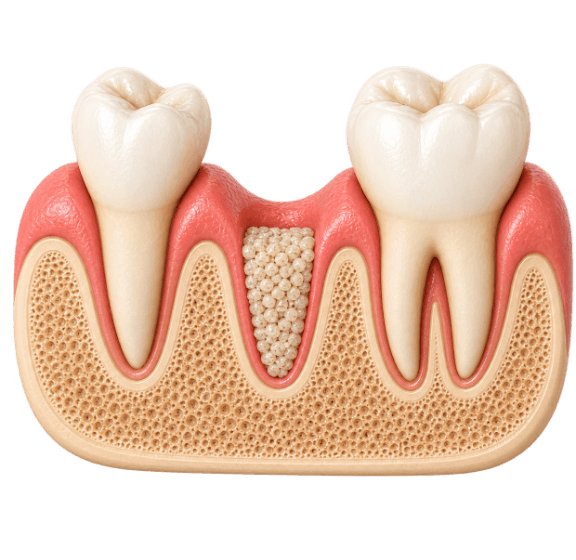
Bone grafting is commonly performed by an oral and maxillofacial surgeon to replace or augment bone in areas of tooth loss. Bone grafting to the jaws and facial structures may be necessary in a wide variety of scenarios. The most common bone grafts are facial skeleton and jaw procedures. Other common procedures include tooth extraction site graft, bone graft reconstruction and for a sinus lift. Shrinkage of bone often occurs when a tooth is lost due to trauma, severe caries, or periodontal disease. Additionally, bone loss may have already occurred due to infection or pathology around a tooth. There are many artificial biocompatible bone substitutes available; however, the best material for a bone graft is your own bone, which most likely will come from your chin, the back part of your lower jaw or your hip bone. The hip is considered to be a better source because the hip bone has a lot of marrow, which contains bone-forming cells. There are also synthetic materials that can be used for bone grafting. Most bone grafts use a person's own bone, possibly in combination with other materials.
To place the removed bone in the recipient site, little holes are drilled in the existing bone to cause bleeding. This is done because blood provides cells that help the bone heal. The block of bone that was removed will be anchored in place with titanium screws. A mixture of the patient's bone marrow and some other bone-graft material will then be placed around the edges of bone block. Finally, a membrane is placed over the area and the incision closed.
The bone graft will take about 6 to 12 months to heal before dental implants can be placed. At that time, the titanium screws used to anchor the bone block in place will be removed before the implant is placed.

Three Common Procedures
Common bone grafting procedures
The alveolar ridge is the bone that surrounds the roots of your teeth. When a tooth is removed, the empty socket usually heals on its own. Sometimes the bone surrounding the socket breaks and cannot heal by itself, and the ridge slowly loses height and width.
A ridge augmentation rebuilds that lost bone by placing graft material in the socket, often immediately after the extraction so a second procedure is not needed. Rebuilding the ridge is not always medically necessary, but it is often required to support a dental implant or to restore the natural contour of the gums and jaw. The procedure is typically performed in office under local anesthesia, with sedation available on request.
The maxillary sinuses sit just above your upper back teeth. When those teeth are removed, often only a thin wall of bone separates the sinus from the mouth, and that thin bone cannot hold a dental implant.
A sinus lift raises the sinus floor and allows new bone to form above the upper jaw. A small opening is made in the bone, the sinus membrane is gently pushed upward, and the space beneath it is filled with grafting material. After several months of healing, the new bone becomes part of your jaw and implants can be placed and stabilized in it. When enough bone already exists to stabilize the implant, the sinus lift and implant placement can sometimes be performed as a single procedure.
When a tooth is extracted, the surrounding bone and gums can shrink and recede quickly, leaving defects that make later restorative work harder, whether that is implants, bridges, or dentures.
Socket preservation prevents that collapse: the socket is filled with bone or bone substitute at the time of extraction and covered so your body can repair it naturally. The healed socket keeps the surrounding gum and facial tissues from shrinking and provides a ready foundation for a future implant. If you are having a tooth removed, especially a front tooth, ask whether socket preservation makes sense for you.
Rebuild the foundation for your smile
Whether you need to preserve a new extraction site or rebuild bone lost years ago, we will show you the clearest path forward.