
Dental Implants · One Missing Tooth
Single Tooth Implants
When one tooth is missing, a single implant replaces it from the root up, without grinding down its healthy neighbors. Dr. Shaun Burlingame and Dr. Francisco Suarez place single tooth implants in office, planned in 3D and performed under your choice of sedation.
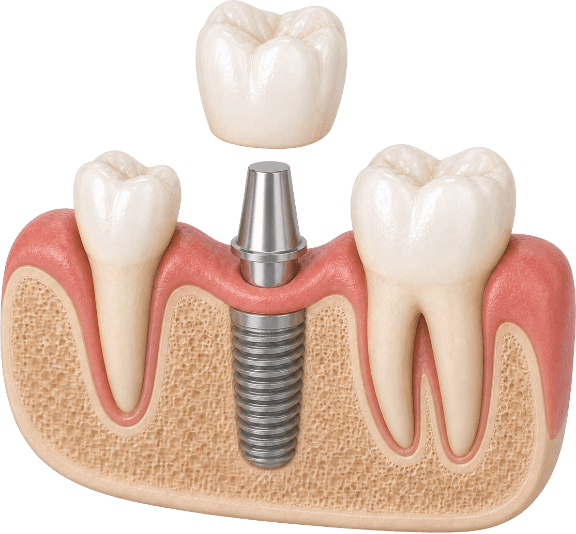
Replacing One Missing Tooth
Single Tooth Implants

Do you have missing teeth? It is critically important to replace missing teeth. Eating and chewing with missing teeth can sabotage your bite and lead to incessant discomfort. Missing teeth can give rise to a mouth rearrangement that often results in facial changes that look decrepit.
A single tooth implant procedure may be done if a tooth has been extracted or is missing. A titanium implant base is placed into the jawbone to resemble the tooth root. We allow a period of time for the jawbone to heal over the implant base before fitting for a crown.
Next, an abutment is screwed into the base of the implant to allow for a crown to be fitted on top. Finally, a custom fabricated crown is placed over the abutment to function like a real tooth.

How It Works
Implant Placement
There are actually two phases to implant dentistry.
Phase 1: Using very accurate surgical techniques, an incision is made in the gum tissues and implants are placed into dimensionally controlled sites (depth and width) in the jawbone.
First, the gum tissue is opened and the jaw bone is tapped with a small drill and then drilled with a wider drill. The implant is inserted into place. The gum tissues are then closed and the healing phase begins. This may take anywhere from 3-6 months to ensure a strong base.
Phase 2: An abutment is secured to the top of the implant placing a new tooth crown onto the implant abutment. Implants can replace a single tooth, several teeth or your dentures.

Why Patients Choose Implants
Implant Benefits
- Eliminates the need to "cut down" the neighboring teeth to make a bridge.
- Maintains the jawbone structure.
- Feels and functions like natural teeth.
- Does not rely on other teeth for support.
- Replaces partial plates and may be used to secure loose dentures.
- Cleaned and flossed like a natural tooth.

Restored self-esteem and renewed self-confidence. Our patients who now enjoy the benefits of their new implant-supported replacement teeth talk openly about their restored self-esteem and self-confidence as a result of a younger appearance, ability to eat the foods they want, increased comfort, and improved overall health.
Improved appearance. Since implants preserve bone, preventing deterioration of the facial structures and appearance is improved. When all the natural teeth are severely compromised or missing, there is nothing left in the jawbone to stimulate bone growth. The body senses that the jawbone is no longer necessary and begins to dissolve it away. This results in facial collapse.
After about ten years, it often becomes difficult to wear a denture because there is little bone left to support it. This results in the lips folding in, and the lower face shriveling up (witches chin) with wrinkles around the mouth making you look like a much older looking person. With dental implants, the appearance of these wrinkles caused by posterior bite collapse or complete facial structure collapse are virtually eliminated.
Remove the embarrassment factor. Implant-supported replacement teeth never have to come out, not for daily cleaning, not for home care hygiene maintenance (brushing and flossing), nor even during a hospital visit or other medical exam. They are permanent. Just like your new smile.
The mouth is restored as closely as possible to its natural state. By replacing the entire tooth, including the root, it is possible to replicate the function of natural teeth with a strong, stable foundation that allows comfortable biting and chewing. In addition, nothing in the mouth looks or feels artificial. Dental implants are the closest thing we have to our natural teeth.
Your smile is improved when replacement teeth look more like natural teeth. Even when only one tooth is missing, long term aesthetics are usually much better with an implant-supported replacement tooth than with a traditional tooth-supported bridge. This is particularly important in the front of your mouth, where preventing a visible bone defect is critical for natural appearance.
Healthy adjacent teeth are not destroyed to replace missing teeth. Tooth replacement with traditional tooth-supported bridges requires grinding down the teeth adjacent to the missing tooth/teeth, so that the bridge can be cemented onto them and into place. This tooth structure can never be replaced and the long-term health of these "prepared" teeth is compromised. Partial dentures have clasps that hook onto adjacent teeth, putting pressure on the adjacent teeth as the partial rocks back and forth. Eventually these teeth can loosen and fail as a result of this unnatural pressure. Replacing missing teeth with implant-supported crowns/bridges does not involve the adjacent natural teeth, so they are not compromised, damaged or destroyed.
Overall quality of life is enhanced with replacement teeth that look, feel and function like natural teeth. With implant-supported replacement teeth, the appearance of the smile is more natural and the teeth function more like natural teeth. The result is increased comfort and confidence when smiling, speaking, and eating. If dentures and partials are replaced with implant-supported teeth, the overall enhancement in quality of life is even more significant, with an ability to eat all types of foods, elimination of messy adhesives, and improved speech, comfort and appearance.
If removable dentures and partials are replaced with implant-supported fixed bridges, the overall enhancement in quality of life is even more significant.
- Your eating habits will improve
- Messy and potentially toxic adhesives used to hold dentures in place are eliminated
- Unsightly destructive metal clasps common with partial dentures, which tend to damage adjacent teeth and gums are now non-existent.
Failing teeth can cause other health issues. It is well documented that periodontal disease is a bacteria-induced chronic infection and inflammatory disease that does not resolve by itself. Unchecked, inflammation and infection contributes to heart attacks, strokes, Alzheimer's disease, diabetes and other chronic diseases. Dentists and cardiologists have long known that neglecting your teeth can lead to more than just a toothache. Scientific studies indicate there is a link between periodontal disease and cardiovascular disease. It has been shown that improving poor oral health can actually improve your overall health.
Convenient oral hygiene. Caring for an implant-supported crown is the same as caring for natural teeth; however, it is one of the most frequently overlooked ingredients in implant success. It is recommended that you request regular dental checkups to have regular dental check-ups and get annual x-rays to make sure the surrounding bone is supporting the implant correctly and to discuss and questions or current concerns you may have. These periodic visits will help keep your replacement teeth healthy for many years to come.
What to Expect
Day Of Treatment
On the day of your appointment please arrive 15-20 minutes prior to your scheduled time. This has proven to help patients settle in and release the pre-surgery nervousness. We will make you as comfortable as possible during your visit.
We recommend bringing along a friend or relative on the day of your treatment. Depending on the procedure itself, you may be receiving anesthesia and possibly other medication during the surgery. It is important that an adult accompany you to the office, stay during the procedure and drive you home after your recovery.
We will provide you with detailed information regarding medication, food, drink, and other preparations that you may need. Please follow their instructions on the day of your treatment. We will also provide you with complete post-surgery instructions including cleaning and maintenance instructions, and if necessary we'll provide you with prescriptions for any medications necessary to reduce the post-surgery discomfort and to help you toward a speedy recovery.
We'll arrange follow-up appointments to assure you maintain a beautiful, natural smile for years to come.

Fewer Visits When Possible
Immediate Placement
In many situations it is possible to remove the diseased and/or loose teeth and replace them with dental implants at the same time. In almost all situations simultaneous bone grafting is completed. This method of treatment reduces the number of surgical visits. It also speeds up the entire process enabling the implants to be ready to receive (caps/crowns) more quickly.
Missing more than one tooth? See Multiple Tooth Implants or All-on-X Full-Arch Implants for options that restore several teeth, or a whole arch, at once.

Replace your missing tooth
Find out whether a single tooth implant fits your needs, and leave with a clear plan for treatment, anesthesia, and cost.