
Dental Implants · Snap-On Stability
Implant-Supported Dentures
A removable denture that snaps securely onto dental implants: no slipping, no adhesives, and you can still take it out to clean. Dr. Shaun Burlingame and Dr. Francisco Suarez place the implants in office, and your denture locks onto them for a stable, comfortable fit.
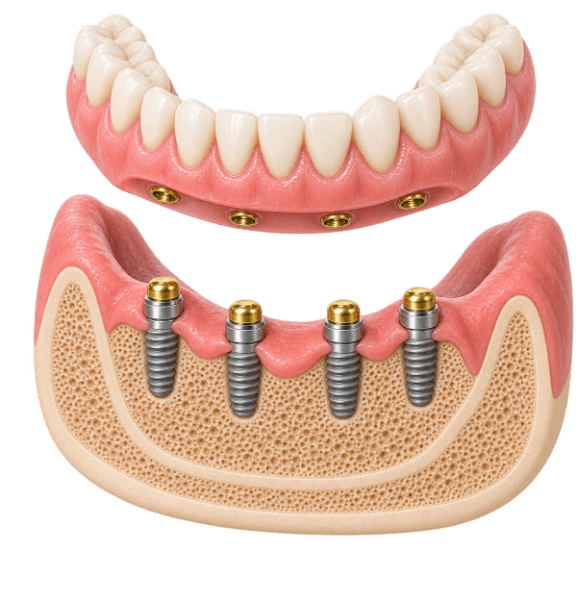
Snap-On Dentures · Overdentures
What Are Implant-Supported Dentures?

Implant-Supported Dentures are a popular treatment option, also known as snap-on dentures or overdentures.
They combine the convenience of removable dentures with the added stability of implants to improve chewing, speech, and comfort.
Unlike traditional dentures that can slip or move around, implant-supported dentures attach securely to dental implants with special connectors.

Here's How It Works
- We bring a wealth of experience in advanced implant surgeries and placing implants into the jawbone with precision and care. Our expertise extends to All-on-X implants, bone augmentation, and sinus floor elevation.
- Connectors, such as suction-type or ball connectors, are added to the implants.
- A denture is then custom-made to lock into these connectors, ensuring a secure and comfortable fit.
This Method Can Work For
- Patients with no remaining teeth (complete dentures).
- Patients with a few remaining teeth (partial dentures).
Why Choose Implant-Supported Dentures?
Compared to traditional dentures, implant-supported dentures offer more comfort, functionality, and durability.
If you've been struggling with loose or uncomfortable dentures, this could be the solution for you.
Is This You?
Ideal Candidates for Implant-Supported Dentures
- People who are dissatisfied with traditional dentures, particularly those that cause irritation, slip or shift excessively during eating or speaking, or feel uncomfortable for long-term wear.
- Patients seeking a more stable and reliable alternative, who are willing to invest a few thousand dollars for improved functionality, comfort, and confidence.
- Those who value a natural look, desiring dentures that stay securely in place while still being removable for easy cleaning and maintenance.
- People tired of relying on adhesives or dealing with the dietary restrictions often associated with loose-fitting traditional dentures.

Why Traditional Dentures Struggle
Addressing Challenges with Traditional Dentures
For patients who experience a strong gag reflex or dissatisfaction with the coverage of the upper denture's palate, implant-supported dentures provide a great solution. By placing just two or more implants, your dentures can gain significant stability.
While upper dentures often have the advantage of suction against the roof of the mouth, lower dentures are more problematic due to the thinner bone structure of the lower jaw. This is why a majority of implant-supported denture cases focus on the lower jaw. However, patients unhappy with their upper dentures or those seeking improvements for both arches often choose upper or full-mouth implant support.
Our team will evaluate your specific concerns and budget to guide you toward the best option.
Implant-supported dentures offer numerous benefits, including:
- Enhanced stability: No more slipping or discomfort.
- Relief from sore spots: Implants reduce reliance on gum suction.
- Improved chewing function: Enjoy your meals with confidence.
Traditional dentures rely solely on suction to stay in place, which can be limiting. Adding a couple of implants dramatically improves retention, giving you a more secure fit and greater overall comfort.
Why Patients Choose Them
Benefits of Implant-Supported Dentures
Implant-supported dentures offer several advantages, making them a popular choice for individuals seeking improved denture stability:
Enhanced Comfort and Functionality
- Implants help stabilize dentures, reducing gum irritation and discomfort.
- No more slipping or shifting dentures allowing you to speak, and smile with confidence. Chewing becomes easier and more comfortable.
- Smaller Upper Denture: Reduces coverage of the roof of the mouth, making it easier to breathe and speak.
Long-term Investment
- Implants are durable and typically last a lifetime.
- Even if dentures are lost or damaged, the implants remain intact, allowing for new dentures to be created without additional implant work.
- Implants help preserve jawbone structure, maintaining oral health in the long run.
Cost and Time Efficiency
- Compared to permanent teeth options like All-on-X, implant-supported dentures are more affordable and quicker to complete.
Procedures are Straightforward
- Implants are placed, and the gums are allowed to heal (typically within a month).
- Customizable Options: You can choose between suction-type or ball connectors based on our team's recommendation.
- Versatile Use: Works with both full and partial dentures.
- Dentures can then be adjusted to lock onto the implants.
- Minimal downtime, reduced pain, and fewer surgeries compared to full-mouth implants.
Attachment Styles
Implant-Supported Denture Treatment Options
When considering implant-supported dentures, you have several options:
Number of Implants
Choose the number of implants based on your needs/budget.
Connector Type
Suction-type or ball-style connectors.
Bar Attachments
For added stability in some cases.
Ball-Style Attachments (Stud Attachments)

Advantages
- Simpler Design: Easy to fabricate and less complex to maintain.
- Cost-Effective: Generally more affordable than bar attachments.
- Maintenance: Individual attachments are easier to replace if they wear out.
- Good Retention: Provides secure anchoring, reducing denture movement during daily activities like eating and speaking.
- Ease of Cleaning: The design allows for straightforward cleaning for patients.
Disadvantages
- Retention Variation: May not provide as uniform retention as bar attachments, especially with multiple implants.
- Stress on Implants: Direct loading of individual implants can cause stress, particularly if the denture is not evenly balanced.
- Limited Applicability: May not be ideal for patients requiring a more rigid connection due to jaw structure or bone loss.
Bar-Style Attachments

Advantages
- Even Load Distribution: The bar connects multiple implants, distributing chewing forces evenly and reducing stress on individual implants.
- Enhanced Stability: Offers a more rigid connection, ideal for patients with higher functional demands.
- Customizability: Can be designed to suit various anatomical and functional requirements.
- Support for Severe Cases: Works well for patients with more advanced bone loss or challenging jaw anatomy.
Disadvantages
- Cost: More expensive due to the complexity of fabrication and additional materials.
- Hygiene Challenges: Requires meticulous cleaning, as the bar can trap food and plaque, increasing the risk of peri-implantitis.
- Complex Repairs: Repairs and adjustments may be more complicated and costly.
- Potential Bulkiness: Can feel bulky in the mouth, which may require adjustment time for patients.
Choosing Between Ball and Bar-Style
The choice between ball-style and bar attachments depends on several factors:
- Patient's anatomy and bone support.
- Budget and willingness to maintain hygiene.
- The doctor's recommendation based on functional and aesthetic needs.
For individuals with sufficient bone support and simpler needs, ball-style attachments are often ideal. For those needing greater stability and even force distribution, bar attachments might be the better option.
Each option's advantages and costs will be explained during your consultation.

Planning Your Treatment
How Many Dental Implants?
Two Implants
- Affordable option providing bilateral stability.
- Ideal for moderate denture looseness.
- Periodic O-ring replacement is part of routine maintenance.
Four Implants
- Offers increased support and stability.
- Reduces the chance of future retention issues.
- Recommended for many upper dentures when the palate is removed.
Bar Attachment Minimum Four Implants
- A custom bar enhances denture tightness.
- The added stability comes with a significant cost increase.
- Some patients choose All-on-X fixed teeth instead at a similar investment.
Typical Implant Recommendations
Upper Dentures
- For full palate removal, four implants are recommended for stability.
- With two implants, some of the palate may need to remain for proper suction.
Lower Dentures
- Two implants may be enough for mild looseness.
- Four may be better if the tongue creates discomfort or excessive denture movement.
Important Considerations
- You can start with two implants and add more later, though that may add cost and inconvenience.
- We will weigh your anatomy, needs, and budget with you.
Step by Step
The Treatment Process for Implant-Supported Dentures
Treatment for implant-supported dentures involves two key components: the implants and the denture.
Treatment Overview
- Initial Consultation: We evaluate your oral health and create a treatment plan.
- Implant Placement: Implants are surgically placed into the jawbone.
- Healing Period: Implants integrate with the bone over a few months.
- Denture Fitting: Your custom dentures are designed and fitted for optimal comfort and stability.
Placing The Implants
- Initial Placement: Typically, 2 or 4 dental implants are placed in the jaw. While some cases may require 3, 5, or 6 dental implants, the most common approach involves 2 or 4 implants.
- Healing Period: After placement, the implants need time to integrate with the jawbone, a process called osseointegration. This can take several weeks to months, depending on the individual.
- Attachment of Connectors: Once the implants heal, small connectors (called abutments) are attached. These will secure the denture in place.
What To Expect
The process of getting implant-supported dentures is generally less painful and more straightforward than many people expect. It comes with fewer complications compared to more advanced treatments like full-mouth implants or All-on-X systems. Since fewer implants are needed and their placement is flexible, these dentures suit nearly everyone. Even patients with limited bone in certain areas often have enough bone in the front of the jaw to accommodate 2-4 implants.
With implant-supported dentures, you can enjoy a secure, comfortable fit, restoring your confidence and quality of life.
Bar Attachment vs. Fixed Full-Arch
Comparing Implant-Supported Denture Options
When considering implant-supported dentures, it's essential to understand the available options and their respective benefits. If you're exploring the bar option, it might also be worthwhile to compare it to the All-on-X system. Here's why:
- All-on-X generally provides superior stability and comfort if you're a suitable candidate.
- The cost difference between a bar system and All-on-X is often negligible.
- With advancements in dental technology, bar systems may not be as beneficial as they once were, except in specific cases.
Summary of the 3 most common implant-supported denture options
- Two-Implant Overdenture: Basic stability for loose dentures.
- Four-Implant Overdenture: Enhanced stability and comfort for daily use.
- Four Implants with a Stabilizing Bar: The tightest and most secure option for overdentures, ideal for those requiring maximum stability.

Honest Expectations
Overdentures: Maintenance and Long-Term Care
- Even with improvements, patients must understand they are still living with dentures, albeit significantly improved dentures.
- While improved, chewing efficiency is not equivalent to natural teeth or permanent implants.
- They require removal for cleaning and may not eliminate psychological discomfort for those wanting a permanent solution like All-on-X.
- Jawbone and cheek volume can still shrink over time.
- Dentures can break if dropped or mishandled.
- Teeth wear down more quickly than permanent implants.
- Ongoing maintenance and adjustments require a skilled dentist.
- Relocating away from your dentist may complicate finding support for repairs or adjustments.
- Components like O-rings may loosen and require replacement.
- Teeth and dentures may need periodic repairs or replacement.
- Annual or biannual dentist visits for maintenance ensure dentures remain tight and functional.
- Cost for maintenance: approximately $120–$250 per visit.
Planning Your Investment
Cost of Implant-Supported Dentures
The cost of dental implants varies based on individual needs. Rather than a fixed price, your treatment plan is customized to support the best outcome for your oral health.
At Riverside Oral Surgery, every patient receives a detailed consultation and written treatment plan.
Factors that influence cost
- Number of implants: Some patients require two implants, while others need four or a full-arch restoration.
- Bone density: Some patients need bone grafting or another preparatory procedure.
- Restoration type: Materials and final denture design affect the total investment.
- Technology and expertise: Advanced imaging, guided surgery, and surgical skill contribute to long-term success.
Insurance Coverage
Implants
Implants are rarely covered by dental insurance for overdentures.
Dentures
- Insurance may cover the denture itself.
- Reimbursement varies widely depending on eligibility and coverage for new dentures.
Suggestions
- Work with our team to determine out-of-pocket costs before treatment.
- Submit claims for any reimbursement your plan may provide.

The Bottom Line
Final Thoughts
At Riverside Oral Surgery, our priority is personalized care. We provide each patient with an in-depth consultation to identify the most suitable treatment options.
Implant-supported dentures are an excellent middle-ground solution for patients who want better dentures without the cost and commitment of permanent implants. Our office's extensive experience with implant-retained prostheses, including complex solutions like All-on-X full arch screw-retained prostheses, ensures that patients receive top-tier care tailored to their needs. These dentures significantly improve chewing, comfort, and overall denture satisfaction.
As long as patients understand they are still wearing dentures, they will likely find this treatment life-changing.
Patient Satisfaction
- Most patients are highly satisfied with implant-supported dentures.
- Most patients never return for additional work apart from routine maintenance.
- A small percentage of patients later upgrade to All-on-X or full-mouth implants, but this is rare.
If you're tired of loose, uncomfortable dentures or are considering a more secure and natural solution, implant-supported dentures may be the perfect option for you. Schedule a consultation today with Riverside Oral Surgery to learn how implant-supported dentures can transform your smile and quality of life.
Contact us today to get started
Find out whether an implant-supported denture is the right fit, with clear answers about your options, anesthesia, and cost.